Durante anos, o mercado global de banheiros inteligentes carregava um estereótipo familiar: Tecnologia japonesa, Marca europeia, Fabricação chinesa.
Em 2026, essa narrativa não conta mais a história completa.
A China não está mais simplesmente montando banheiros inteligentes para marcas estrangeiras. Tornou-se o centro operacional da cadeia global de fornecimento de sanitários inteligentes - controlando não apenas a produção de cerâmica e a integração electrónica, mas cada vez mais a engenharia, testes de conformidade, e desenvolvimento ODM por trás de muitos dos produtos vendidos em todo o mundo.
De acordo com múltiplas previsões do setor, o mercado global de banheiros inteligentes atingiu aproximadamente US$ 5.1 bilhão em 2025 e está projetado para exceder USD 9.2 bilhão por 2034. A Ásia-Pacífico já representa mais de 74% da demanda global, com a China funcionando como a espinha dorsal da produção de toda a região.
O que mudou não foi apenas a escala de produção. É o surgimento de um ecossistema industrial totalmente interligado.
Hoje, um banheiro inteligente desenvolvido para um varejista europeu pode usar:
- um corpo cerâmico produzido em Chaozhou,
- um sistema de controle projetado em Taizhou,
- montagem e integração ODM de Xiamen,
- e embalagem de canal coordenada por Foshan.
Poucos países conseguem replicar este nível de concentração industrial.
A indústria de banheiros inteligentes da China entrou em uma fase diferente
Entre 2015 e 2020, A indústria de banheiros inteligentes da China expandiu-se a uma velocidade extraordinária.
As vendas da indústria cresceram de aproximadamente RMB 4.4 bilhões para mais de RMB 15 bilhões em cinco anos, com taxas de crescimento anuais próximas 30%. Por 2024, vendas anuais de banheiros inteligentes na China ultrapassaram 11 milhões de unidades, enquanto o tamanho do mercado interno atingiu aproximadamente RMB 17 bilhão.
Ao mesmo tempo, o mercado também ficou lotado.
A rápida expansão das marcas online de baixo custo desencadeou uma concorrência agressiva de preços, especialmente no segmento de entrada abaixo do RMB 2,000. Muitas fábricas dependiam de fornecimento fragmentado, controle de qualidade solto, e ciclos curtos de produtos.
Esse período está terminando.
A partir de julho 1, 2025, China implementou oficialmente certificação CCC obrigatória para produtos sanitários eletrônicos. Banheiros inteligentes sem certificação não podem mais ser fabricados ou vendidos legalmente no mercado interno.
A política é importante muito além do mercado retalhista chinês.
Para compradores estrangeiros, o regulamento sinaliza uma mudança estrutural: A indústria de sanitários inteligentes da China está a passar de um fabrico de baixas barreiras para uma consolidação industrial orientada para a conformidade.
Fábricas com capacidade de teste, infraestrutura de certificação, e sistemas de engenharia estáveis estão ganhando participação. Oficinas de montagem menores e operações comerciais não conformes estão sendo eliminadas.
O resultado é uma cadeia de abastecimento mais forte – e cada vez mais capaz de servir os mercados premium globais.
Quatro clusters industriais alimentam silenciosamente a indústria
O que torna a China difícil de substituir não é apenas o custo da mão-de-obra. É a especialização de regiões industriais inteiras.
A cadeia de fornecimento de sanitários inteligentes do país está concentrada em quatro grandes clusters industriais, cada um desempenhando uma função diferente dentro do ecossistema.
Taizhou: O cérebro de engenharia da indústria de banheiros inteligentes da China
Taizhou, na província de Zhejiang, é amplamente considerado o berço da indústria de banheiros inteligentes da China.
A história remonta à década de 1990, quando empresários locais começaram a fazer engenharia reversa de assentos de bidê japoneses importados. Por 2003, As empresas de Taizhou já desenvolveram o primeiro banheiro inteligente integrado da China.
Hoje, Taizhou continua mais forte em:
- sistemas de controle eletrônico,
- tecnologias de aquecimento,
- assentos de bidê inteligentes,
- desenvolvimento de firmware,
- e gerenciamento preciso de temperatura.
Muitos dos primeiros padrões nacionais de banheiros inteligentes da China foram elaborados por empresas sediadas em Taizhou.
O que distingue Taizhou é a profundidade da engenharia.
Os principais fabricantes investiram pesadamente em sistemas de simulação digital, laboratórios de testes ambientais, e algoritmos de temperatura PID capazes de controlar flutuações de temperatura da água dentro de ±0,1°C.
As fábricas lá também passaram anos resolvendo problemas raramente visíveis para os consumidores:
- tubos congelados em climas do norte,
- ambientes de tensão instáveis,
- lavagem com baixa pressão de água,
- e confiabilidade de impermeabilização a longo prazo.
Mas Taizhou também tem uma fraqueza estrutural.
Ao contrário de Chaozhou ou Foshan, falta uma base local de produção de cerâmica. Os corpos cerâmicos devem ser transportados de outras províncias, aumentando os custos logísticos e desacelerando os ciclos de produção.
À medida que os banheiros inteligentes integrados se tornaram populares, Taizhou mudou gradualmente para uma função mais especializada:
sistemas eletrônicos de alto valor e tecnologia de assento inteligente.
Chaozhou: O centro de fabricação de banheiros inteligentes mais agressivo do mundo
Se Taizhou fornecer o “cérebro,”Chaozhou fornece o corpo.
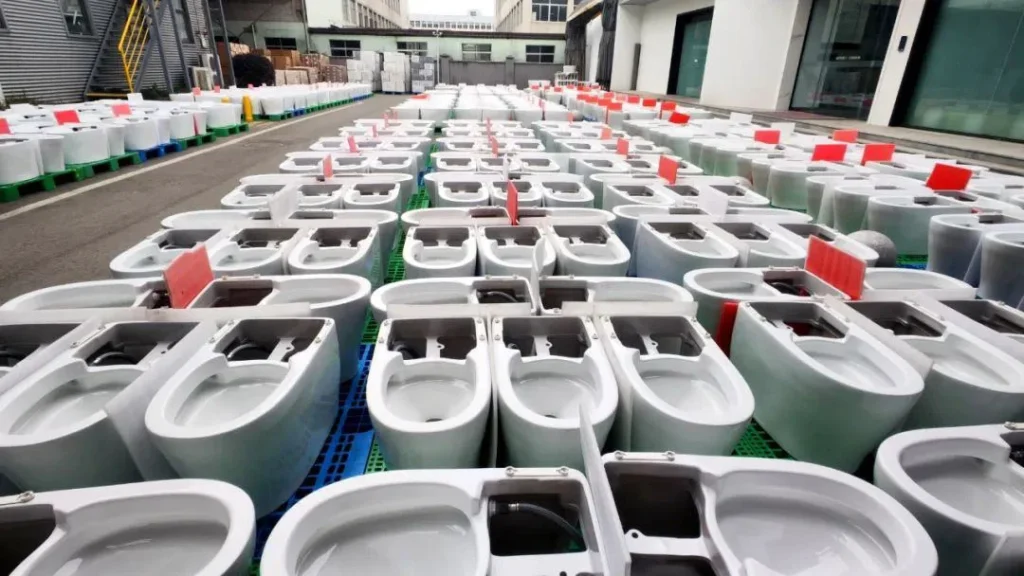
Localizado na província de Guangdong, Chaozhou produz aproximadamente 40% da produção de cerâmica sanitária da China e tornou-se a região dominante de montagem de sanitários inteligentes integrados no país.
Caminhando por Fengtang ou Guxiang, zonas industriais inteiras giram em torno da produção de banheiros inteligentes:
fornos cerâmicos, oficinas de moldes, linhas de montagem, fábricas de embalagens, fornecedores de espuma, e depósitos logísticos operando a poucos quilômetros um do outro.
Mais do que 800 empresas de louças sanitárias estão concentradas na área.
Esta densidade muda dramaticamente a economia.
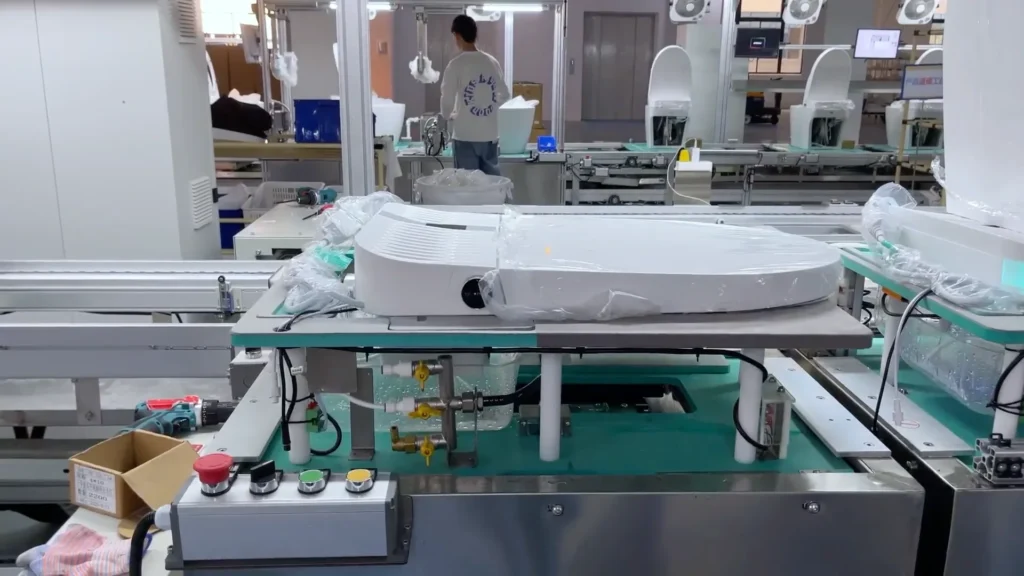
Uma fábrica pode adquirir corpos cerâmicos localmente, integrar sistemas de bidê inteligentes de fornecedores de Taizhou, montar unidades acabadas, imprimir a marca do cliente, e enviar contêineres de exportação dentro de prazos extremamente reduzidos.
Essa flexibilidade de fabricação ajudou Chaozhou a se tornar a base OEM preferida para:
- marcas de banheiros inteligentes on-line,
- vendedores de comércio eletrônico transfronteiriços,
- importadores de marca própria,
- e cadeias de varejo orientadas para o valor.
Dentro da indústria, alguns fabricantes descrevem Chaozhou como “o Huaqiangbei dos banheiros inteligentes” – movimento rápido, sensível ao custo, e extraordinariamente adaptável.
Mas a região também tem enfrentado críticas pela qualidade inconsistente e workshops fragmentados.
Nos últimos anos, os governos locais aceleraram campanhas de consolidação industrial visando fábricas não licenciadas e operações falsificadas. Iniciativas de padronização e parques industriais estão substituindo gradativamente o antigo modelo de oficina.
A mudança é especialmente importante agora que a aplicação da certificação CCC tornou-se mais rigorosa.
Xiamen: Capital ODM de alta qualidade da China
Se Chaozhou dominar a produção em escala, Xiamen domina ODM de ponta.
A indústria de banheiros inteligentes da cidade cresceu a partir do investimento anterior de Taiwan e evoluiu para um dos ecossistemas de louças sanitárias mais sofisticados do mundo.
Hoje, Xiamen é o lar de:
- fabricantes de banheiros listados publicamente,
- Laboratórios certificados pelo CNAS,
- centros de design industrial,
- e alguns dos fornecedores ODM mais avançados do setor.
Muitos compradores internacionais conhecem as marcas.
Poucos conhecem as fábricas por trás deles.
Uma percentagem significativa de assentos sanitários inteligentes premium vendidos globalmente é produzida em cadeias de abastecimento baseadas em Fujian. Marcas internacionais de banheiros de luxo – incluindo vários nomes europeus e japoneses – dependem da fabricação chinesa ODM para partes de suas linhas de produtos.
Alguns fabricantes chineses agora detêm:
- milhares de patentes,
- sistemas de teste internos,
- e capacidade de certificação em mais de 80 países e regiões.
O modelo de negócios também evoluiu.
As fábricas OEM anteriores concentravam-se na fabricação com base nos desenhos dos clientes. Os fornecedores de Xiamen operam cada vez mais como parceiros ODM:
desenvolvendo tecnologias internas, desenhos industriais, sistemas de descarga, e plataformas eletrônicas que marcas globais posteriormente personalizam.
Esta é uma das mudanças menos compreendidas na indústria.
A China não está mais apenas produzindo banheiros inteligentes.
Cada vez mais os está projetando.
Foshan controla a economia do canal
Foshan ocupa uma posição diferente na cadeia de abastecimento.
A cidade funciona menos como um centro de produção e mais como sede comercial da indústria de banheiros da China.
Muitas das principais marcas de louças sanitárias da China estabelecidas:
- operações de vendas,
- gestão de varejo,
- sistemas de revendedor,
- e redes de showroom
em Foshan.
A cidade conecta fábricas a:
- redes varejistas nacionais,
- distribuidores de melhorias residenciais,
- canais de comércio eletrônico,
- e sistemas de comércio de exportação.
Em muitos casos, os produtos vendidos sob grandes marcas de banheiro ainda são fabricados em outros lugares – geralmente em Taizhou ou Xiamen – enquanto Foshan gerencia a marca, distribuição, e operações de canal.
Esta separação entre produção e controle de canal é cada vez mais comum em toda a indústria.
Por que os compradores globais continuam a adquirir produtos da China
O aumento dos custos trabalhistas levou muitas indústrias a diversificar a produção no Sudeste Asiático.
Banheiros inteligentes são diferentes.
O produto combina:
- cerâmica,
- sistemas de água,
- componentes de aquecimento,
- placas de controle eletrônico,
- sensores,
- conectividade sem fio,
- e estrita conformidade com a segurança.
Muito poucas regiões possuem todas essas capacidades simultaneamente.
A China faz.
Mais importante, essas capacidades já existem dentro de clusters industriais interconectados com infraestrutura de exportação madura.
Um comprador que compra da China muitas vezes pode concluir:
- desenho industrial,
- ferramentas,
- teste de certificação,
- Personalização ODM,
- embalagem,
- e carregamento de contêineres
dentro de um ecossistema integrado.
Replicar essa rede em outro lugar leva anos.
A conformidade está se tornando a verdadeira barreira competitiva do setor
Durante grande parte da década anterior, preços baixos dominaram o mercado.
A próxima fase provavelmente será determinada pela certificação e confiabilidade da engenharia.
Banheiros inteligentes combinam água, eletricidade, e calor dentro de ambientes úmidos. Isso cria requisitos de conformidade significativos para:
- proteção contra vazamento,
- resistência ao fogo,
- isolamento à prova d'água,
- compatibilidade eletromagnética,
- e eficiência energética.
Os fabricantes que visam a América do Norte e a Europa precisam cada vez mais:
- Certificação CE,
- Conformidade com UL,
- Teste FCC,
- Registro DOE,
- e certificações energéticas regionais.
Fábricas sem sistemas de testes internos lutam para competir internacionalmente.
Esta é outra razão pela qual os grandes fabricantes de ODM estão ganhando vantagem.
A infraestrutura de conformidade é cara – mas uma vez estabelecida, torna-se um fosso competitivo de longo prazo.
2026 Pode se tornar um ponto de viragem
Várias forças da indústria estão agora convergindo simultaneamente.
Primeiro, A taxa de penetração de banheiros inteligentes domésticos na China permanece surpreendentemente baixa – aproximadamente 5%, muito abaixo dos mercados maduros, como o Japão.
Segundo, produtos vendidos durante o boom da indústria em torno 2018 estão se aproximando do ciclo de substituição recomendado de aproximadamente oito anos.
Terceiro, A certificação CCC obrigatória está eliminando muitos fornecedores instáveis de baixo custo.
Junto, estes factores podem desencadear uma grande remodelação da capacidade de produção a partir de 2026.
Os prováveis vencedores não são necessariamente as fábricas mais baratas.
São os fabricantes capazes de equilibrar:
- conformidade,
- engenharia,
- produção escalável,
- e capacidade ODM internacional.
E no centro dessa transformação continua a cadeia de abastecimento de casas de banho inteligentes, exclusivamente interligada da China..
Para compradores globais, a questão não é mais se a China fabrica banheiros inteligentes.
A verdadeira questão é com que parte do ecossistema da cadeia de abastecimento da China eles escolhem trabalhar.